The almost-right build.
The agent built most of it. But “most” isn’t a list you can review.
Make every agreement explicitA working app isn’t always the app you asked for.
Walkdown brings the spec, the design, and the running build
together—so nothing gets lost on the way to done.
You have the prototype. You have the pull request. Somewhere between them, the empty state disappeared, the interaction changed, and a decision got buried in a chat.
Your tests can pass while the product still misses the point. Walkdown makes that gap visible.
The agent built most of it. But “most” isn’t a list you can review.
Make every agreement explicitThe requirement changed. Yesterday’s green check didn’t get the memo.
Know when evidence goes stale“That button, on that screen.” Context lost. Another round of explaining.
Keep the conversation attachedThe review happens where the product happens.
Your actual app, with the agreement right beside it.
Not a manually updated status. Every rule shows its checks, agent review, and human signatures—derived from the evidence. Unjudged work stays visible.
REAL CAPTURE / RULE BOARD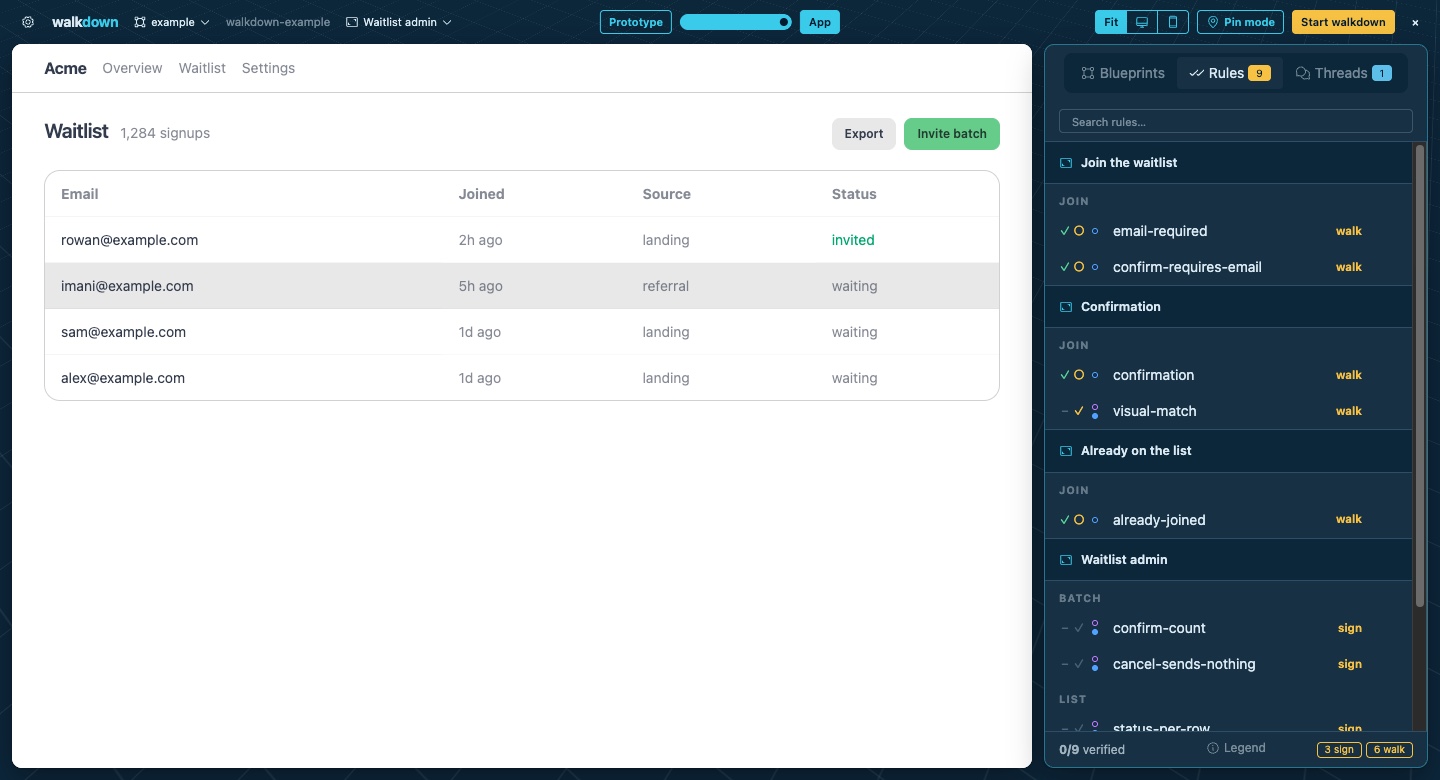
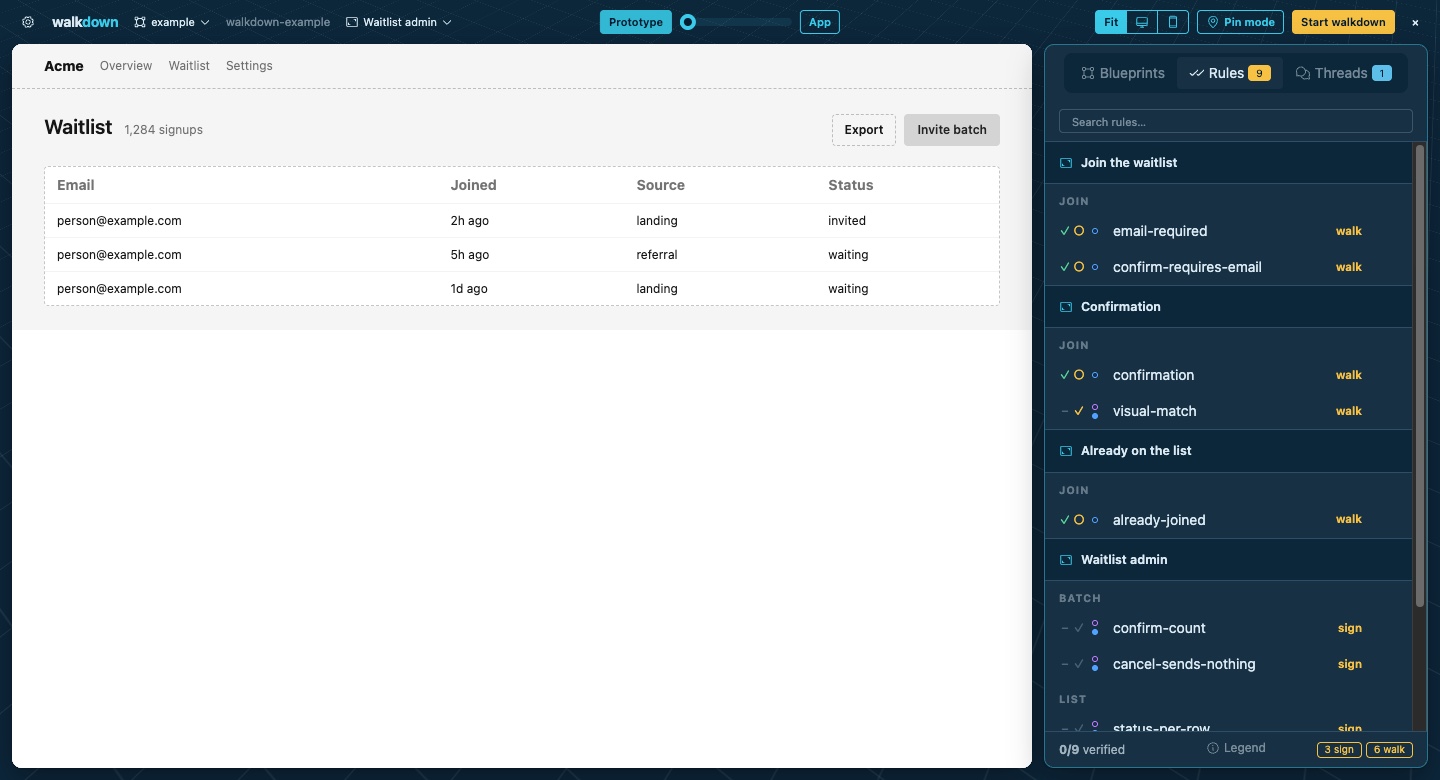
Walkdown fades the prototype over your running app at the same viewport. Try this screenshot comparison to spot what changed—without switching windows.
INTERACTIVE / SCREENSHOT COMPARISONPin feedback to an element. Ask a question against a rule. Answers get folded into the blueprint, so the next agent gets the decision—not just another chat to search.
REAL CAPTURE / INCORPORATED QUESTIONThree kinds of verification. Three different jobs.
Each one earns the next one’s attention.
Your existing tests catch regressions. Tag them to rules; Walkdown connects the results. No second test suite to maintain.
An agent reads the rule and tries the app. It compares, investigates, and records evidence before asking for your attention.
You review what matters and sign for your role. An agent can claim the work is fixed. It cannot accept it on your behalf.
When the agreement changes, the evidence should too.
A pass against an older rule is marked stale—not quietly carried forward as green.
Your designs and requirements become plain-language rules. Your agents build against them. Your team reviews the same agreement in the browser.
Underneath it all? Files you own, a CLI, and an append-only record of what was actually verified.
Explore the thinking behind Walkdownid: invites.batch.confirm-count
statement: >
Inviting a batch asks for
confirmation naming how many
people will be emailed.
verify:
- checks
- agent
signoff: [eng, product]No. Walkdown links acceptance rules to the tests you already own. Playwright, RSpec, and node:test have reporters; the runner contract lets other frameworks participate. Your suite stays your suite.
Walkdown’s server runs locally. Blueprints, threads, and verification records are files you control. Any AI agent you choose to use has its own data handling and service terms.
No. You can review and approve the specification before the build exists. Walkdown distinguishes approval of the wording from verification of the working product.
Highball enforces your repository’s engineering checks while an agent builds. Walkdown asks whether the built product matches the agreed intent. They complement each other; they don’t share a verdict.
Meet Highball ↗Give your agent a blueprint. Give yourself the final word.
Read https://github.com/profoundry-us/walkdown/blob/main/site/setup.md and set Walkdown up for this project.